- Roasts may be seasoned before, during or after cooking, since salt penetrates only to about ½ inch.
- Boned and rolled roasts require approximately 10 minutes per pound more cooking time than roasts with the bone left in.
- Pot-roasts, Swiss steaks, “birds,” chops and other cuts cooked by braising should be browned slowly in order to retain the attractive brown color during cooking.
- Steaks, chops and patties broiled at moderate temperatures require only one turning during cooking.
- Meat cuts cooked in liquid increase in weight and are juicier if they are allowed to cool in the cooking liquid and under refrigeration.
- Low temperature cookery yields 10 to 30 per cent more meat to serve.
- Meat that is overcooked shrinks more, is less palatable, less attractive and more difficult to carve.
- Searing does not seal in meat juices but actually increases cooking losses.
- Turning meat occasionally during panbroiling insures even cooking throughout the cut.
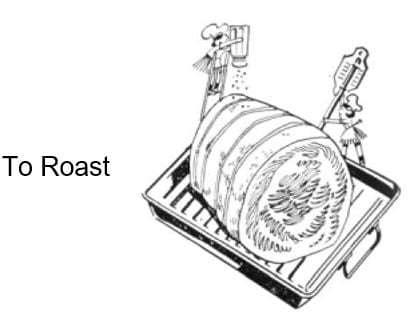
- Season with salt and pepper.
- Place meat fat side up on rack in open roasting pan.
- Insert meat thermometer.
- Do not add water. Do not cover. Do not baste.
- Roast in a slow oven (300° F. for beef, veal, lamb, and smoked pork; 350° F. for fresh pork).
- Roast to desired degree of doneness.
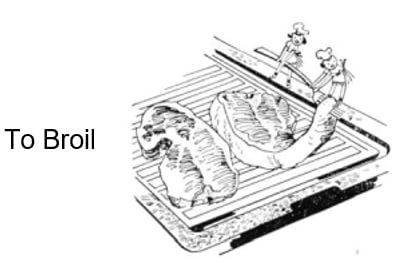
- Set oven regulator for broiling.
- Place meat 2 to 3 inches from heat.
- Broil until top of meat is brown.
- Season with salt and pepper.
- Turn meat and cook until done.
- Season and serve at once.
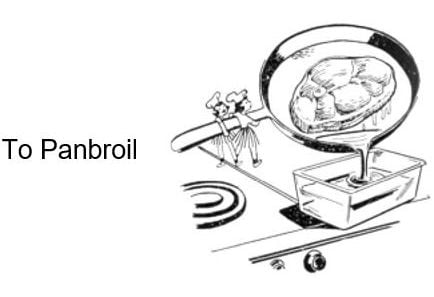
- Place meat in heavy frying-pan.
- Do not add fat. Do not add water. Do not cover.
- Cook slowly, turning occasionally.
- Pour fat from pan as it accumulates.
- Brown meat on both sides.
- Season. Serve at once.
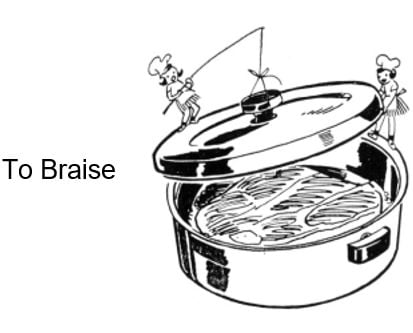
- Brown meat on all sides in fat in heavy utensil.
- Season with salt and pepper.
- Add small amount of liquid, if necessary.
- Cover tightly.
- Cook at low temperature until tender.
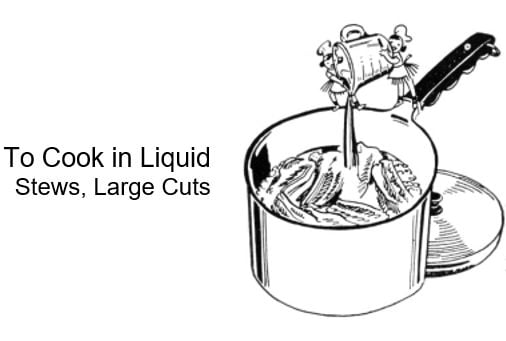
- Brown meat on all sides in own fat or lard, when desirable.
- Season with salt and pepper.
- Cover with liquid, cover kettle, cook below boiling point until tender.
- Add vegetables just long enough before serving to be cooked.
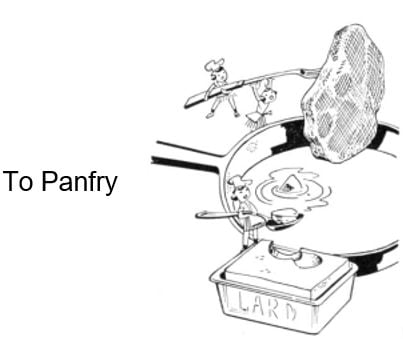
- Brown meat on both sides in small amount of fat.
- Season with salt and pepper.
- Do not cover.
- Cook at moderate temperature until done, turning occasionally.
- Remove from pan and serve at once.
- Pot-roasts, other braised dishes and stews may be conveniently cooked in a moderate oven (300° F. to 350° F.)
- Meat cubes are browned for a brown stew; browning is omitted if a light stew is preferred.
- A roast meat thermometer is inserted so the bulb reaches the center of the largest muscle but does not rest in fat or on bone.
- Cooked meat should be stored closely covered in the coldest part of the refrigerator.
- All meat is tender if cooked by the correct cookery method.
- Steaks and chops for broiling should be cut at least an inch thick.
- Panbroiling is a convenient method for cooking thin beef or lamb steaks, chops or patties and smoked ham slices, bacon and Canadian-style bacon.
- Roasts are more easily carved if the meat is allowed to “set” 20 to 30 minutes before carving.
- For ease in carving, have the back bone loosened on beef rib and pork loin roasts before cooking.
- A roast meat thermometer registers the internal temperature or degree of doneness of a roast.
Next Chapter | Top of Page

